10th September- The Hindu Newspaper Analysis
Page 04: GS II : Governance
Context
The Union Government's decision to advance the Population Enumeration phase of Census 2027 in four poll-bound States (UP, Punjab, Uttarakhand, Goa) and include expanded identity-related questions has reignited debate over Census data integrity. Former Census officials have raised technical concerns regarding data confidentiality, under-enumeration risks, and the structural linkages between the Census, National Population Register (NPR), and National Register of Citizens (NRC).
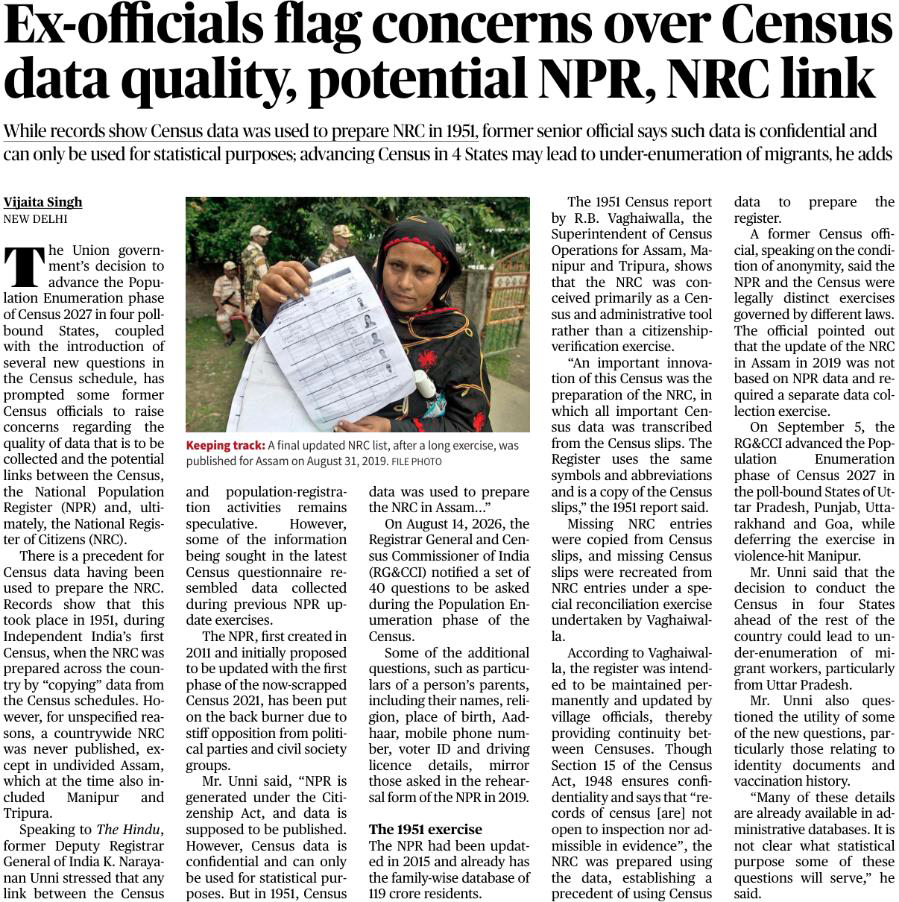
Key Concerns Raised by Former Officials
Confidentiality vs. Administrative Usage:
Census data is legally mandated for macro-statistical purposes only.
The inclusion of personal identity attributes (Aadhaar, Voter ID, Passport, parents' birth details) in the notified 40-question Census schedule mirrors data collected in the 2019 NPR rehearsal form.
Historical precedent from the 1951 Census shows Census slips were transcribed to create Assam's initial NRC, creating a technical friction point with current statutory protections.
Risk of Under-Enumeration:
Advancing the Census schedule exclusively in select source States (e.g., Uttar Pradesh) ahead of destination States risks missing seasonal and interstate migrant populations, causing data skew.
Redundancy & Data Quality:
Information such as ID proofs and vaccination records already exists in administrative databases (e.g., CoWIN, UIDAI), raising questions regarding the statistical necessity of collecting them during household enumeration.
Related Static Dimensions (UPSC Framework)
Statutory & Legal Framework:
Census Act, 1948 (Section 15): Guarantees strict confidentiality. Mandates that Census records are not open to public inspection nor admissible as evidence in legal proceedings.
Citizenship Act, 1955 & Citizenship Rules, 2003: Provide the legal framework for the creation of the NPR (register of usual residents) and the NRC (register of verified citizens).
Data Governance & Privacy Principles:
Purpose Limitation: Under data protection principles (K.S. Puttaswamy v. Union of India, 2017), data collected for macro-demographic statistics should not be cross-linked with identification registers without explicit legal safeguards.
Institutional Governance:
Office of the Registrar General and Census Commissioner of India (RG&CCI): Functions under the Ministry of Home Affairs (MHA) to conduct demographic surveys and manage population registers.
Key Distinctions: Census vs. NPR vs. NRC
Legal Basis:
Census: Governed by the Census Act, 1948.
NPR & NRC: Governed by the Citizenship Act, 1955 and Citizenship Rules, 2003.
Target Population:
Census & NPR: Enumerate all usual residents (including foreign nationals staying >6 months).
NRC: Contains data specifically of verified Indian citizens.
Public Nature of Data:
Census: Individual details remain confidential by law; only aggregated data is published.
NPR/NRC: Designed as published administrative databases subject to verification and local objections.
Conclusion
Maintaining the functional separation between statistical data collection (Census) and individual identity verification (NPR/NRC) is critical to preserving public trust. Adherence to Section 15 of the Census Act, 1948 ensures respondent honesty, safeguarding the scientific validity of India’s fundamental demographic repository.
UPSC Prelims Practice Questions Question: With reference to the Census in India, consider the following statements: 1. The Census is conducted under the Census Act, 1948. 2. Individual census records are subject to statutory confidentiality protections. 3. Census information is primarily intended for producing aggregate demographic statistics. Which of the statements given above are correct? A. 1 and 2 only B. 2 and 3 only C. 1 and 3 only D. 1, 2 and 3 Ans:D) UPSC Mains Practice Questions Question: “The credibility of the Census depends as much on public trust as on administrative capacity.” Discuss. (10 Marks, 150 Words) |
Page 04 : GS III : Environment
Context
A recent working paper by the World Resources Institute (WRI) India reveals a critical seasonal spike in urban air pollution: open waste burning triples during winter across Indian cities compared to summer. Driven by stagnant atmospheric conditions, lower ambient temperatures, and unequal municipal infrastructure, open waste burning poses a severe localized public health risk, particularly for vulnerable socioeconomic groups.

Key Findings of the WRI India Study
Seasonal Surge:
Incidence of burning, volume of waste burned, and corresponding emissions increase by up to three times in winter relative to summer.
Tier-Wise Variations:
Tier-2 Cities (Population: 0.5 to 5 million): Accounted for the highest absolute volume of waste burned.
Tier-3 Cities: Recorded the highest frequency/density of winter burning incidents, averaging 49.6 incidents/km²/day (compared to 46 in Tier 2 and 39.4 in Tier 1).
Localized Health Impact vs. Citywide Footprint:
Waste burning contributes less than 1% to total citywide PM2.5 and PM10 loads.
However, ground-level proximity to residences and streets causes acute short-term toxic exposure, posing severe respiratory hazards.
Socioeconomic Disparities:
Poorer neighborhoods experienced significantly higher burning rates due to systemic gaps in municipal waste collection.
The highest recorded burning density occurred in low-income zones of Tier-2 cities during winter (~84 incidents/km²/day).
Related Static Dimensions (UPSC Framework)
Statutory Framework:
Solid Waste Management (SWM) Rules, 2016: Expressly bans open burning of solid waste on public, private, or commercial premises. Directs local bodies to establish segregation and processing infrastructure.
Air (Prevention and Control of Pollution) Act, 1981: Empowers State Pollution Control Boards (SPCBs) to enforce air quality standards and penalize illegal emission sources.
Environmental & Atmospheric Dynamics:
Thermal Inversion: Winter atmospheric trapping prevents vertical dispersion of pollutants, keeping ground-level emissions concentrated near breathing zones.
Ground-Level Toxins: Burning mixed municipal waste releases high levels of hazardous pollutants, including dioxins, furans, black carbon, and heavy metals.
Institutional Governance & Challenges:
Municipal Capacity Deficits: Tier-2 and Tier-3 urban local bodies (ULBs) face resource constraints, weak collection mechanisms, and insufficient waste processing capacity.
Commission for Air Quality Management (CAQM): Mandated to address regional air quality issues in the National Capital Region (NCR) and adjoining areas through coordinated monitoring.
Key Drivers: Why Open Waste Burning Escalates in Winter
Municipal Service Deficits: Inadequate door-to-door collection in informal and low-income settlements leads to localized waste accumulation and burning for disposal.
Space Heating Needs: Low-income populations often burn accumulated dry waste and biomass for warmth during winter cold waves.
Seasonal Leaf Litter: Post-monsoon and autumn leaf drop increases combustible organic biomass in urban areas, leading to open burning.
Conclusion
Addressing winter open waste burning requires shifting from end-of-pipe enforcement to structural municipal reforms. Strengthening door-to-door waste collection in low-income pockets, enforcing the SWM Rules 2016, and equipping Tier-2 and Tier-3 ULBs with proper waste processing infrastructure are essential to eliminating localized toxic exposure and achieving equitable air quality management.
UPSC Prelims Exam Study Questions Question: Which of the following best explains why an emission source can have a relatively small citywide contribution to PM2.5 but still produce substantial health impacts? A. Pollutants emitted near the ground can create high local concentrations and direct exposure. B. PM2.5 is harmless when emitted in small quantities. C. Citywide averages automatically exclude residential areas. D. Local emissions are converted into oxygen before reaching the atmosphere. Ans: A) UPSC Mains Exam Study Questions Question: Open waste burning is a localised but significant public-health hazard in Indian cities. Discuss its causes, environmental consequences and mitigation measures.(10 Marks, 150 Words) |
Page 05:GS II : Indian Polity
Context
The Union Ministry of Home Affairs (MHA) has proposed establishing an directly elected body for the Union Territory (UT) of Ladakh by introducing a new constitutional provision, Chapter 'K', under Article 371. This sui-generis governance model seeks to grant legislative safeguards over local identity and resources while balancing Union administration in the strategic border region.
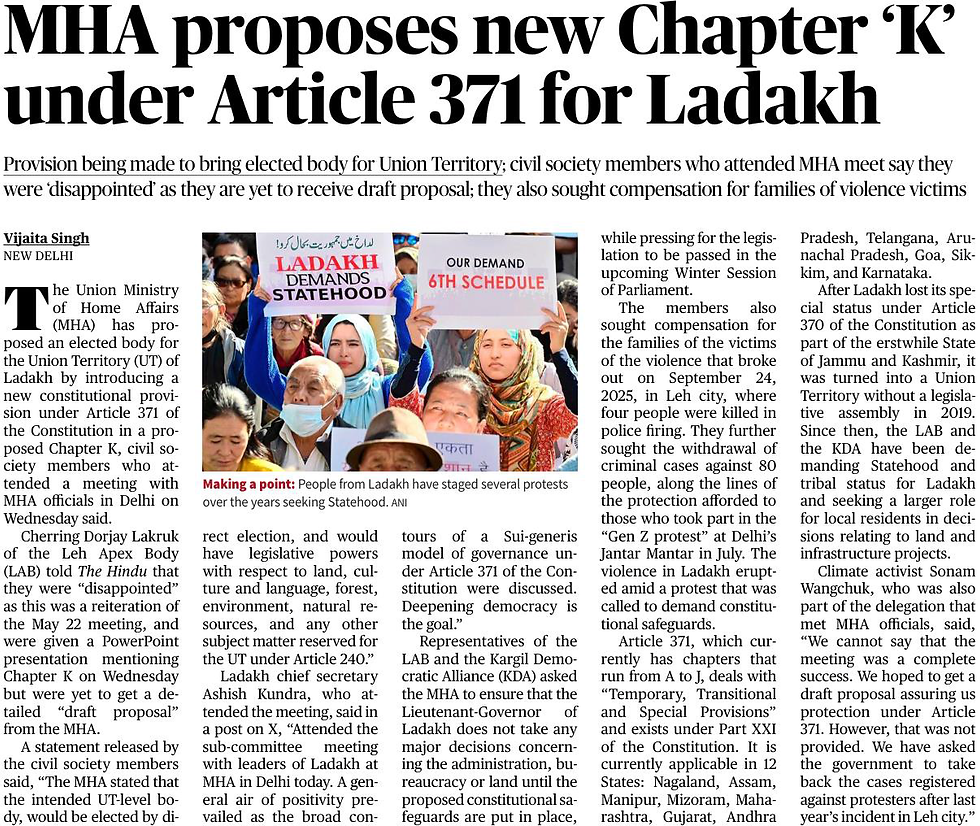
Key Aspects of the MHA Proposal & Regional Demands
Proposed Constitutional Framework (Chapter 'K'):
Envisages a directly elected UT-level body with legislative powers covering land, culture, language, forests, environment, natural resources, and subjects under Article 240.
Intended as a constitutional mechanism under Part XXI to protect local interests without full statehood.
Concerns Raised by Civil Society (LAB & KDA):
Lack of Formal Draft Text: Representatives expressed disappointment over being shown only a PowerPoint presentation rather than a negotiated draft Bill text.
Scope of Control: Stakeholders are seeking legislative authority over local administration, police, and bureaucracy, which remain unaddressed in the preliminary outline.
Interim Moratorium Demand: Demanded that the Lieutenant-Governor (L-G) hold off on major administrative and land decisions until safeguards are enacted in Parliament.
Legal Relief & Compensation: Requested financial compensation for families of victims of past violence and the withdrawal of criminal cases filed against local protesters.
Related Static Dimensions (UPSC Framework)
Part XXI of the Constitution (Special Provisions):
Article 371 (A to J): Contains tailored administrative safeguards for 12 states (e.g., Article 371A for Nagaland, 371G for Mizoram) to accommodate cultural identity, land ownership rights, and customary laws.
Asymmetric Federalism: Demonstrates the constitutional flexibility to accord varying degrees of autonomy to regions based on historical, strategic, or demographic requirements.
Union Territory Governance Framework:
Article 239 & 240: Article 239 governs direct UT administration via the L-G, while Article 240 empowers the President to make regulations for specific UTs.
Reorganisation Context: Following the 2019 bifurcation of Jammu & Kashmir under Article 370, Ladakh was designated a Union Territory without a legislature, centralizing decision-making under the L-G.
Alternative Demands — Sixth Schedule vs. Article 371:
Sixth Schedule (Article 244): Focuses on tribal self-governance through Autonomous District Councils (ADCs) with specific revenue-raising and judicial powers.
Article 371 Amendment: Functions via parliamentary legislation creating a region-specific macro-assembly structure at the state or UT level.
Institutional Distinction: Proposed Chapter K vs. Existing Sixth Schedule
Structural Architecture:
Proposed Chapter K: Establishes a centralized, UT-wide legislative assembly directly elected by residents.
Sixth Schedule: Creates decentralized Autonomous District Councils (ADCs) operating at regional/district tiers.
Legislative Jurisdiction:
Proposed Chapter K: Broad legislative mandate over land, natural resources, environment, culture, and statutory subjects.
Sixth Schedule: Focuses on customary law, local land allotment, inheritance, and village administration.
Conclusion
The MHA’s proposal to introduce Chapter 'K' under Article 371 marks a shift toward establishing a formal constitutional setup for Ladakh. Fulfilling local governance aspirations effectively will depend on providing a concrete draft text, clearly delineating powers between the elected body and the Lieutenant-Governor, and establishing financial and administrative clarity.
UPSC Prelims Practice Questions Question: The Sixth Schedule of the Constitution primarily provides for: A. Direct administration of all tribal areas by the Union Government B. Autonomous governance through District and Regional Councils in specified tribal areas of the Northeast C. Special legislative powers for all Union Territories D. Creation of State Legislatures in Scheduled Areas Ans: B) UPSC Mains Practice Questions Question: Examine the constitutional significance of Article 371 and its differentiated approach to regional governance. (10 Marks, 150 Words) |
Page 09:GS II : Social Justice
Context
Driven by judicial intervention from the Supreme Court, the Food Safety and Standards Authority of India (FSSAI) has proposed a red hexagonal Front-of-Pack Nutrition Label (FOPNL) for packaged foods high in fat, salt, or sugar (HFSS). While marking a critical shift in public health communication, expert consensus indicates that warning labels alone are insufficient to counter India's growing childhood obesity, type-2 diabetes, and non-communicable disease (NCD) crisis without broader structural and fiscal reforms.
Key Issues & Policy Gaps Highlighted
Scale of Childhood Obesity & Unhealthy Marketing:
According to the World Obesity Atlas 2026, 41 million Indian children and adolescents (aged 5–19) are overweight or obese.
Ultra-processed ultra-cheap foods, "health drinks," and energy drinks are heavily marketed to minors under misleading wholesome or energetic claims.
Enforcement & Institutional Gaps:
Existing school canteen recommendations from CBSE and FSSAI remain largely advisory and unenforced.
A major limitation of packaged food regulation is its inability to reach the vast unorganised food sector (street vendors, dhabas, sweet shops), which accounts for a substantial share of total trans-fat, salt, and sugar consumption.
Flaws in the Fiscal/Tax Structure:
India currently levies a 40% GST slab broadly across all aerated and sweetened beverages, treating regular sugary colas and zero-sugar alternatives identically.
This flat tax structure eliminates financial incentives for manufacturers to reformulate recipes to lower sugar content.
Related Static Dimensions (UPSC Framework)
Constitutional Mandate:
Article 21 (Right to Life & Health): The Supreme Court has repeatedly affirmed that the constitutional Right to Life encompasses the right to health, imposing a affirmative duty on the State to protect citizens from avoidable health risks.
Article 47 (Directive Principles): Directs the State to raise the level of nutrition and the standard of living of its people, and to consider the improvement of public health as among its primary duties.
Regulatory & Statutory Framework:
Food Safety and Standards Act, 2006: Empowers FSSAI to establish science-based standards for food items and regulate their manufacture, storage, distribution, and sale.
Dietary Guidelines for Indians (2024): Formulated by ICMR-NIN, these provide the scientific thresholds for defining "High Sugar," "High Salt," and "High Saturated Fat" levels.
Global Best Practices (Fiscal & Regulatory):
Tiered Sugar Tax (U.K. Model): A graduated soft drinks industry levy that taxes beverages based on tiered sugar thresholds, forcing widespread industry reformulation without imposing uniform consumer price shocks.
Warning Labels (Chile/Mexico Model): Combines bold black/red warning octagons with strict prohibitions on marketing labelled products to children or using cartoon mascots on packaging.
Policy Matrix: Current vs. Proposed Reform Architecture
Front-of-Pack Labeling (FOPNL):
Current Mechanism: Fine-print Nutritional Information Table on the back of packaging (BOPNL).
Proposed Reform: Bold, red hexagonal front-of-pack warnings for HFSS products.
Indirect Taxation (GST on Sugar):
Current Mechanism: Flat 40% GST on aerated/sweetened beverages regardless of actual sugar concentration.
Proposed Reform: Tiered sugar-content tax structure to incentivize product reformulation.
Target Population & Scope:
Current Mechanism: Exclusively targets organised, packaged food brands.
Proposed Reform: Mandatory baseline standards for organized canteens, marketing restrictions aimed at children, and gradual safety norms for unorganised retail.
Conclusion
The FSSAI’s proposed front-of-pack red warning label is a vital regulatory first step toward informed consumer choice. However, tackling India's non-communicable disease burden requires a holistic public health strategy: combining mandatory front-of-pack warnings with strict restrictions on child-directed marketing, a calibrated tiered sugar tax, and targeted capacity-building within the unorganised food sector.
UPSC Mains Exam Study Questions Question: “The Gram Sabha is not merely an administrative consultative body but an instrument of participatory self-governance in Scheduled Areas.” Discuss in the context of PESA and the Forest Rights Act. (10 Marks, 150 Words) |
Page : 08 Editorial Analysis Page
GS Paper II: International Relations UPSC Mains Exam Practice Questions: Discuss the constitutional framework governing Union Territories under Articles 239 and 240. How does it differ from State governance?(15Marks, 250 Words) |
Context :
The article, authored by UAE Minister of State Saeed bin Mubarak Al Hajeri, emphasizes how economic cooperation within BRICS should deliver tangible opportunities, stability, and shared prosperity. Highlighting the bilateral relationship between the UAE and India under India’s 2026 BRICS Chairship, the piece outlines a vision where global economic integration is strengthened through robust trade, capital flows, logistics networks, and societal connections.
Key Analytical Takeaways
Core Operational Principle:
Economic cooperation must move beyond high-level dialogue to practical implementation—facilitating trade, investment, supply chain resilience, and connectivity for member states and the broader Global South.
The Strategic Role of Diversity:
Complementarity among BRICS economies—connecting capital sources, energy exporters, manufacturing hubs, and large consumer markets—creates shared economic strength amidst rising global trade restrictions.
UAE–India Bilateral Model:
Trade Momentum: Following the Comprehensive Economic Partnership Agreement (CEPA), non-oil trade expanded by 17% (exceeding $76 billion in 2025), targeting $200 billion by 2032.
Beyond Trade: The relationship is driven by capital mobility, research, education, and people-to-people connections.
The UAE's Value Proposition to BRICS:
High economic diversification (non-oil sectors accounting for nearly 79% of GDP in 2025).
Significant capital deployment capabilities, with sovereign wealth assets exceeding $2.9 trillion and 38 concluded CEPAs.
Robust development finance integration through active participation in the New Development Bank (NDB), which has approved over $40 billion in regional infrastructure projects.
Related Static Dimensions (UPSC Framework)
Multilateral Economic Architecture:
BRICS Expansion & Dynamics: Represents an expanding block of major emerging economies aiming to reform global governance, facilitate local currency trade settlements, and build alternative financial institutions.
New Development Bank (NDB): Headquartered in Shanghai, the NDB finances infrastructure and sustainable development projects in BRICS and other developing countries, serving as a non-Bretton Woods development finance mechanism.
India’s Foreign & Economic Policy:
Neighborhood and Extended Neighborhood Strategy: Deepening linkages with the Gulf Cooperation Council (GCC) through economic agreements, trade corridors, and diaspora integration.
India’s 2026 BRICS Chairship: Focused on the theme "Building for Resilience, Innovation, Cooperation and Sustainability", prioritizing people-centric growth, trade facilitation, digital public infrastructure, and climate action.
Institutional Economic Tools:
Comprehensive Economic Partnership Agreements (CEPA): Free trade agreements covering trade in goods, services, investment, and regulatory cooperation to reduce tariffs and non-tariff barriers.
Institutional Focus: Structural Framework of India–UAE Bilateral Ties
Trade & Investment Mechanisms:
Driven by CEPA provisions, joint venture investments, and sovereign wealth fund allocations targeting renewable energy, infrastructure, and technology sectors.
Strategic Connectivity Projects:
Positioning as key nodes in broader trans-regional trade networks (such as the India-Middle East-Europe Economic Corridor framework), leveraging UAE logistics hubs (ports, airports) and Indian industrial capabilities.
Socio-Economic Ties:
Supported by a large Indian expatriate workforce in the UAE, robust remittance flows, cultural exchange, and institutional collaboration in higher education and innovation.
Conclusion
As India leads the 18th BRICS Summit, the UAE–India economic framework offers a practical template for intra-BRICS cooperation. By converting multilateral dialogue into resilient supply chains, capital alignment, and people-to-people connections, the grouping can foster tangible economic development across the Global South.

Comments