13th August 2026 | Nagaland Current Affairs News Analysis (Prelims+Mains)
Topic 1- NFSA Implementation and Ration Card Deletions in Nagaland
GS Paper II – Government Policies and Interventions for Development in various sectors and issues arising out of their Design and Implementation; Issues relating to Poverty and Hunger.

Context
The National Food Security Act (NFSA), 2013, forms the bedrock of India's social safety net, aiming to ensure food and nutritional security by providing subsidized food grains to nearly two-thirds of the country’s population.
Recent data presented in the Lok Sabha by the Ministry of Consumer Affairs, Food & Public Distribution reveals that 11,876 ration cards were deleted or cancelled in Nagaland between 2022 and 2025. While targeted deletion drives aim to eliminate duplicate, ghost, or ineligible beneficiaries, ensuring that genuine and vulnerable households are not excluded due to administrative or technical glitches remains a critical challenge under the Public Distribution System (PDS).
Key Highlights of the Lok Sabha Data
Deletion Trends in Nagaland (2021–2025)
According to official figures provided by Minister of State Nimuben Jayantibhai Bambhaniya, Nagaland experienced significant fluctuations in ration card cancellations over the last five years:
2021: 0 cancellations recorded.
2022: 3,428 ration cards deleted.
2023: 3,177 ration cards deleted.
2024: Peak deletions recorded at 3,924 cards.
2025: Cancellations declined to 1,347 cards.
Year | Number of Deletions / Cancellations |
2021 | 0 |
2022 | 3,428 |
2023 | 3,177 |
2024 | 3,924 (Highest) |
2025 | 1,347 |
Total | 11,876 |
Measures to Prevent Exclusion under Targeted PDS (TPDS)
To safeguard eligible beneficiaries against exclusion caused by technical, logistical, or biometric failures, the Ministry has introduced several institutional and technological safeguards:
Multi-Modal Authentication Mechanisms
To overcome single-point authentication failures at electronic Point of Sale (e-PoS) devices:
Provisions include single-finger biometric scans, fusion-finger authentication, iris scanning, and One-Time Passwords (OTP).
Family Member Authentication: If the primary cardholder fails biometric verification, any eligible family member registered under the same ration card can authenticate and draw the foodgrain entitlement.
Offline Functionality of e-PoS Devices
To address persistent network and connectivity issues—particularly prevalent in hilly and remote regions like the North-East—e-PoS devices are equipped to operate offline during transaction processing and sync data once internet connectivity is restored.
Nominee Facility
In exceptional cases involving elderly, bedridden, or disabled beneficiaries who cannot visit fair price shops (FPS), states allow authorized nominees to collect rations on their behalf.
Policy Advisory against Right-Denial
The Union Government has explicitly instructed States and Union Territories that no genuine beneficiary should be denied foodgrain quotas due to network failures, biometric mismatch, or missing identity linkages.
Challenges Associated with Ration Card Management in Remote Regions
Exclusion Errors vs. Inclusion Errors: While cleaning database entries removes "ghost" cards, strict verification mechanisms risk excluding vulnerable populations lacking robust identity linkages or suffering from worn biometrics (e.g., manual laborers, elderly).
Terrain and Connectivity Disruption: In states like Nagaland, rugged topography frequently impairs real-time e-PoS data synchronization and mobile networks.
Biometric Failure Rates: High failure rates during fingerprint scanning due to age, physical labor, or device malfunctions disproportionately affect marginal communities.
Conclusion & Way Forward
The periodic review and cancellation of ration cards are essential steps toward plugging leakages and enhancing the fiscal efficiency of the Targeted Public Distribution System. However, technology should act as an enabler rather than a barrier to welfare delivery.
To bridge the gap between efficiency and social inclusion:
Hybrid Verification Options: Non-biometric fallbacks (such as local social audit verification or manual logging with supervisory oversight) must remain operational for failed biometric cases.
Infrastructure Strengthening: Upgrading e-PoS hardware and expanding off-grid internet solutions in remote North-Eastern regions will reduce technical disruptions.
Regular Social Audits: Community-led social audits under NFSA should be conducted routinely to identify erroneously excluded families and ensure prompt restoration of benefits.
Practice UPSC Questions Prelims Question Q1. With reference to the National Food Security Act (NFSA), 2013, consider the following statements:
(c) 1 and 3 only (d) 1, 2, and 3 Correct Answer: (d) Explanation: All three statements represent statutory provisions under NFSA 2013. Mains Question Q. "Technology-driven reforms in the Targeted Public Distribution System (TPDS) have significantly reduced leakages, yet inclusion and exclusion errors persist." Discuss this statement in light of recent ration card rationalization drives and technological safeguards under the National Food Security Act (NFSA). (15 Marks, 250 Words) |
Topic 2- High HIV Prevalence in Nagaland: Challenges & Mitigation Strategies
GS Paper II – Issues Relating to Development and Management of Social Sector/Services relating to Health; GS Paper III – Role of External State and Non-state Actors in Creating Challenges to Internal Security (Substance Abuse Linkages).

Context
India’s fight against HIV/AIDS has yielded significant progress nationally, but regional disparities persist, particularly in the North-Eastern states. According to recent data released by the National AIDS Control Organisation (NACO) and highlighted during the launch of the Intensified IEC Campaign 3.0, Nagaland ranks second in India in adult HIV prevalence at 1.37%, trailing only Mizoram (2.73%), and significantly above the national average of 0.20%.
While the state has recorded positive trajectory indicators—including a 39.97% decline in new HIV infections and an 80.21% reduction in AIDS-related deaths since 2010—the high baseline prevalence underscores an urgent need for targeted, terrain-sensitive, and community-driven public health interventions.
Key Highlights from the Report
Current Burden & Spatial Distribution
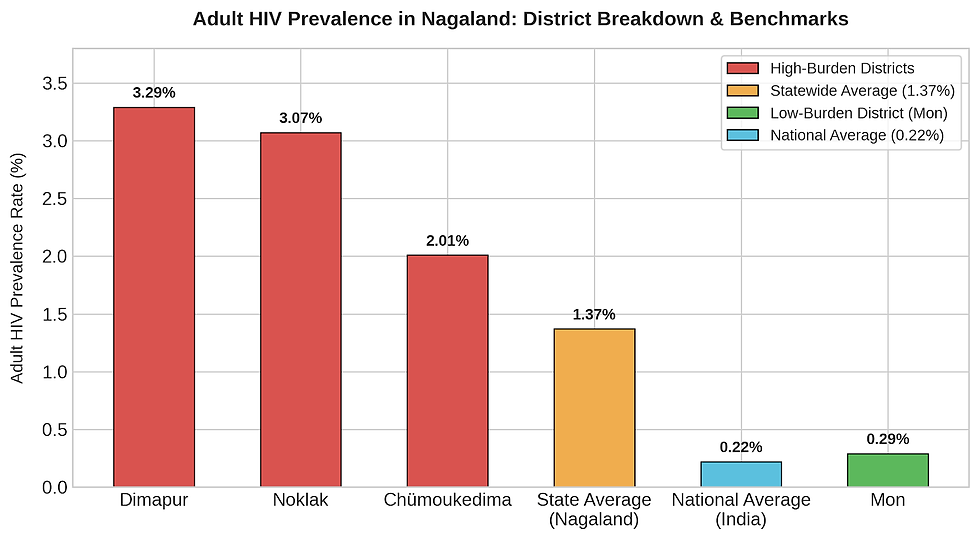
Prevalence Rate: Nagaland's adult HIV prevalence stands at 1.37%, with an estimated 23,470 people currently living with HIV (PLHIV) in the state.
District-wise Variation:
Highest Positivity Rate: Dimapur recorded the highest rate at 3.29%, followed by Noklak (3.07%) and Chümoukedima (2.01%).
Moderate Prevalence: Peren, Mokokchung, Zunheboto, and Longleng.
Lowest Prevalence: Mon recorded the lowest rate at 0.29%.
Major Drivers of HIV Transmission in the North-East
Injecting Drug Use (IDU): The proximity of North-Eastern states to the "Golden Triangle" (Myanmar, Laos, Thailand) facilitates illicit drug trafficking, making unsafe needle sharing among Injecting Drug Users a major vector for transmission.
Heterosexual Route & Transmission Dynamics: High rates of unprotected sexual encounters and general population spillover from key populations (Injecting Drug Users, Female Sex Workers).
Difficult Terrain & Access Barriers: Rugged topography and poor connectivity in hilly districts hinder regular testing, counseling, and consistent Anti-Retroviral Therapy (ART) adherence.
Stigma & Delayed Diagnosis: Socio-cultural taboos surrounding STIs and drug use deter individuals from seeking early diagnostic and care services.
Government Interventions & Key Initiatives
1. Intensified IEC Campaign 3.0
Launched on International Youth Day by the Department of Health & Family Welfare (H&FW), Government of Nagaland, in partnership with NACO.
Core Objective: Transition from "awareness to action" by penetrating every village across Nagaland by October 2026.
Youth-Centric Approach: Engagement of schools, colleges, youth organizations, and social media tools to promote safer behaviors and break social stigma.
2. "Health on Bike" Outreach
Innovative Last-Mile Delivery: Deployment of customized motorbikes to reach remote and underserved areas (e.g., Niuland, Tseminyu, Tuensang, Longchem in Mokokchung, and Tobu in Mon).
Services Provided: Door-to-door testing, distribution of preventive kits, counseling, and delivery of ART drugs.
3. Triple Elimination Target
Nagaland's public health framework aligns with the national goal for the triple elimination of mother-to-child transmission of HIV, Syphilis, and Hepatitis B.
Key Challenges Facing the Program
Testing Gap vs. Low Case Counts: Lower recorded figures in certain districts may indicate inadequate testing facilities rather than an actual lower disease burden.
Supply Chain Disruption: Ensuring an uninterrupted supply of ART medication and diagnostic kits to remote health centers in hilly terrains remains a persistent logistical hurdle.
Sustaining Adherence: Long-term compliance with ART regimes among rural and marginalized populations is hampered by economic hardship and migration.
Conclusion & Way Forward
To achieve the global target of ending AIDS as a public health threat by 2030, Nagaland’s response must balance high-tech interventions with community-level grassroot strategies.
Strengthening Harm Reduction Programs: Expand Needle-Syringe Exchange Programs (NSEP) and Opioid Substitution Therapy (OST) centers, particularly in border districts.
Community-Led Health Governance: Involve village councils, church groups, and civil society organizations (CSOs) to destigmatize testing and foster local ownership of health campaigns.
Strengthening Primary Health Infrastructure: Institutionalize mobile health clinics and expanding "Health on Bike" units to ensure geographic barriers do not obstruct access to essential care.
Integrated Health Delivery: Synergize HIV/STI programs with drug rehabilitation and tuberculosis (TB) control drives to address co-infections effectively.
Practice UPSC Questions Prelims Question Q1. With reference to HIV/AIDS in India, consider the following statements:
Which of the statements given above is/are correct? (a) 1 and 2 only (b) 3 only (c) 1 and 3 only (d) 1, 2, and 3 Answer: (b) Explanation:
Mains Question Q. "Geographical isolation and social stigma complicate public health delivery in India's North-Eastern region." In the context of high HIV prevalence in states like Nagaland and Mizoram, critically analyze the challenges in health interventions and suggest innovative strategies to overcome them. (15 Marks, 250 Words) |
Topic 3- Boycott of Independence Day Events over Mandatory 'Vande Mataram': Constitutional Analysis
GS Paper II – Indian Constitution: Features, Amendments, Significant Provisions and Basic Structure; Fundamental Rights (Article 25); Special Provisions for States (Article 371A); Issues relating to Federalism.
Context
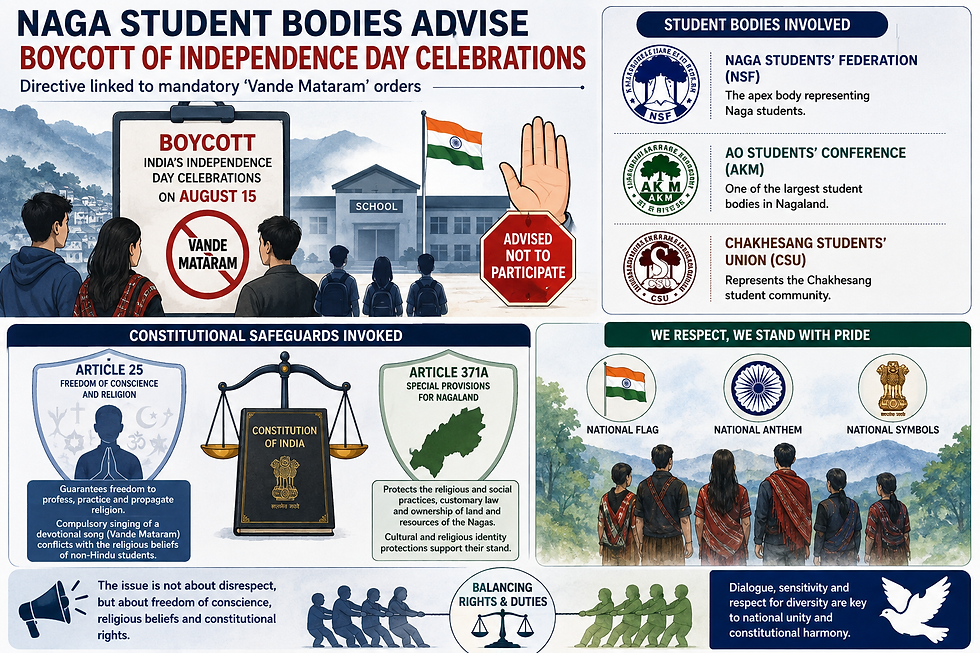
The Naga Students’ Federation (NSF), along with its federating units such as the Ao Students’ Conference (AKM) and the Chakhesang Students’ Union (CSU), recently issued directives advising schools and educational institutions under their jurisdictions to refrain from sending students to participate in India's Independence Day celebrations on August 15.
The boycott directive specifically stems from objections to mandatory orders regarding the playing or singing of the National Song, Vande Mataram. While affirming full respect for the National Flag, the National Anthem, and national symbols, the student bodies invoked constitutional safeguards—specifically Article 25 (Freedom of Conscience and Religion) and Article 371A (Special Provisions for Nagaland)—stating that compulsory participation in a devotional song conflicts with the religious beliefs of non-Hindu students.
Key Facts & Contention
Scope of Objection: The NSF clarified that it does not oppose the celebration of Independence Day or the honoring of national symbols. The objection is strictly limited to the compulsory singing or playing of Vande Mataram.
Reference to Official Orders: The student bodies cited a Union Ministry of Home Affairs (MHA) communication regarding the popularization and compulsory singing/playing of Vande Mataram in official functions.
Protection against Disciplinary Action: Subordinate bodies were directed to ensure that students exercising their right to refrain on grounds of conscience face no intimidation, discrimination, or academic penalties.

Constitutional & Judicial Dimensions
1. Freedom of Conscience and Religion (Article 25)
Article 25(1) guarantees all persons equal entitlement to freedom of conscience and the right freely to profess, practise, and propagate religion.
Religious Imagery: Opposition to Vande Mataram among certain non-Hindu communities stems from the song’s historical text, which personifies the nation as a mother goddess, conflicting with strict monotheistic tenets.
Coercion vs. Voluntary Participation: Constitutional jurisprudence establishes that forcing an individual to perform an act that violates their sincerely held religious conscience breaches Fundamental Rights under Article 25.
2. Landmark Precedent: Bijoe Emmanuel v. State of Kerala (1986)
The Supreme Court of India handled a similar issue when students belonging to the Jehovah’s Witnesses faith were expelled for refusing to sing the National Anthem (Jana Gana Mana), though they stood respectfully.
Court Ruling: The Apex Court held that expelling students who refrain from singing the National Anthem out of genuine religious conscience violates their fundamental rights under Article 19(1)(a) (Freedom of Speech and Expression) and Article 25(1).
Standing Respectfully: The Court noted that standing up respectfully during the anthem demonstrates proper respect, and compulsion to sing is not mandated by the Prevention of Insults to National Honour Act, 1971.
3. Article 371A: Special Provisions for Nagaland
Article 371A of the Indian Constitution grants special constitutional autonomy to Nagaland:
It stipulates that no Act of Parliament in respect of religious or social practices of the Nagas, Naga customary law and procedure, or ownership/transfer of land shall apply to the State unless the Legislative Assembly of Nagaland by resolution so decides.
The invocation of Article 371A underscores the high sensitivity around central directives impacting local socio-religious norms.
4. Fundamental Duties (Article 51A) vs. Fundamental Rights
Article 51A(a) states that it is the duty of every citizen to abide by the Constitution and respect its ideals and institutions, the National Flag, and the National Anthem.
Notably, while the National Anthem (Jana Gana Mana) is explicitly mentioned under Fundamental Duties and protected under the Prevention of Insults to National Honour Act, 1971, Vande Mataram holds the status of National Song, where mandatory singing provisions carry complex legal and constitutional debates.
Conclusion & Way Forward
The issue highlights the continuous interplay between civic nationalism, constitutional rights, and cultural pluralism in India's federal setup.
Adhering to Supreme Court Guidelines: Respecting national symbols does not require enforcing mandatory vocal participation when it conflicts with religious conscience, provided due respect (such as standing silently) is displayed.
Consultative Federalism: Central advisories and state-level implementation should account for regional socio-cultural sensitivities and unique constitutional safeguards like Article 371A.
Preventing Coercive Measures: Educational institutions must ensure that constitutional freedoms are upheld without subjecting students to academic or administrative penalties for exercising freedom of conscience.
Practice UPSC Questions Prelims Question Q1. With reference to the Indian Constitution and judicial precedents regarding National Symbols, consider the following statements:
Which of the statements given above are correct? (a) 1 and 2 only (b) 2 and 3 only (c) 1 and 3 only (d) 1, 2, and 3 Answer: (a) Explanation:
Mains Question Q. "The Indian Constitution balances national unity with religious and regional diversity." Examine this statement in light of Article 25 and special constitutional provisions such as Article 371A, with reference to controversies surrounding mandatory national practices in educational institutions. (15 Marks, 250 Words) |

Comments