5th September- The Hindu Newspaper Analysis
Page 01: GS III : Science and Tech
Context
The Indian Space Research Organisation (ISRO) achieved a critical milestone with the successful launch of the EOS-05 earth observation satellite aboard the GSLV-F17. Placing a 2,367-kg satellite into a sub-geosynchronous transfer orbit provides a major boost to India's space program following recent setbacks with the PSLV missions. Operating from a geosynchronous orbit ~36,000 km above Earth, EOS-05 acts as a continuous "eye in the sky," delivering real-time, high-resolution strategic and civilian data.

Deep Analysis & Strategic Significance
Continuous Surveillance Capabilities: Unlike Low Earth Orbit (LEO) satellites that pass over specific regions intermittently, a geosynchronous earth observation satellite remains fixed over one region, ensuring round-the-clock real-time tracking of weather, disasters, and border areas.
GSLV Vehicle Optimization: The payload capacity of the GSLV has increased from 1,536 kg (GSLV-D1) to 2,367 kg, reflecting significant technical refinements in structural weight reduction and cryogenic propulsion efficiency.
Restoration of Operational Confidence: Successful deployment overcomes previous launch anomalies (such as the GSLV-F10 and PSLV-C62 failures), reinforcing the reliability of India's heavy launch capabilities for upcoming domestic and commercial payloads.
Multi-Sectoral Value: Real-time data feeds directly into precision agriculture, marine environmental monitoring, disaster management, and early warning systems for natural hazards.
Related Static Dimensions (UPSC Syllabus Core)
GS Paper III - Space Technology:
Geosynchronous vs. Polar Orbits: EOS-05 operates at ~36,000 km (GEO) matching Earth's rotation period, whereas PSLV missions typically launch into Polar/Sun-Synchronous Orbits (600–800 km) for periodic global coverage.
Cryogenic Upper Stage (CUS): The GSLV relies on indigenous cryogenic engines using liquid hydrogen (LH2) and liquid oxygen (LOX), which offer high specific impulse required for heavy GEO deployments.
GS Paper III - Disaster Management: Real-time monitoring significantly improves flood mapping, cyclone tracking, and forest fire surveillance, reducing response latency during crisis management.
Key Operational Milestones (Point-Wise Flow)
Pre-Launch Prep: Payload optimization and structural refinements on the 19th flight of the GSLV (GSLV-F17).
Lift-Off & Ascent: Liftoff from the Second Launch Pad at Satish Dhawan Space Centre, Sriharikota.
Orbital Injection: Precise injection of the 2,367-kg EOS-05 payload into Sub-GTO 18 minutes post-launch.
Solar Deployment & Health Check: Verification of valve operation, solar array deployment, and onboard telemetry health.
Orbit Raising: Planned chemical propulsion maneuvers to raise the apogee/perigee into the final geostationary slot at 36,000 km.
Conclusion
The EOS-05 mission demonstrates ISRO's resilience and engineering adaptability. By pioneering continuous earth observation from a geosynchronous orbit, India strengthens both its national security apparatus and socio-economic capabilities in agriculture and disaster management.
UPSC Prelims Practice Questions Question: The principal advantage of a geostationary satellite for continuous weather monitoring is that: A. It has no orbital motion around Earth B. It remains apparently fixed relative to a location on Earth's surface C. It operates only over the polar regions D. It can observe only one point on Earth Ans: B) UPSC Mains Practice Questions Question:“India's space programme is increasingly shifting from launch capability to application-oriented space infrastructure.” Discuss.(10 Marks, 150 Words) |
Page 04 : GS II & III : International Relations & Indian Economy
Context
The high-level dialogue in Mumbai between Belgian Prime Minister Bart De Wever and Indian Commerce Minister Piyush Goyal marks a pivotal juncture in bilateral relations, catalyzed by the landmark India-European Union Free Trade Agreement (FTA). By positioning the Port of Antwerp-Bruges as India's primary gateway to Europe, the partnership addresses the growing global need for supply-chain diversification amidst rising trade protectionism.

Strategic and Economic Significance
Tariff Elimination and Market Access: The India-EU FTA targets the elimination or reduction of tariffs on over 95% of goods, unlocking a $24 trillion market representing roughly a quarter of global GDP and two billion people.
Advanced Logistics Infrastructure: The Port of Antwerp-Bruges provides specialized capabilities, including world-first unbroken cold-chain logistics for pharmaceuticals and efficient food processing corridors, functioning as a direct entry point into the European consumer market.
Diversified Sectoral Cooperation: Bilateral engagement extends beyond traditional gems and jewellery ($3.5 billion trade volume) into high-growth areas like lab-grown diamond technology, green hydrogen value chains, maritime services, and defense industrial collaboration.
Sub-National Growth Synergy: Maharashtra’s ambitious roadmap toward a $1-trillion economy by 2030 creates a localized engine for European investment, capital deployment, and skill-sharing.
UPSC Static Dimensions (GS Paper II & III)
International Relations (GS-II): India-EU strategic partnership, plurilateral trade frameworks, and hedging against arbitrary trade barriers and geopolitical volatility.
Indian Economy & Infrastructure (GS-III): Mechanics of Free Trade Agreements, port-led industrial development (aligning with domestic initiatives like Sagarmala), and clean energy cooperation through green hydrogen corridors.
Industrial Manufacturing & Gems: The transition from natural diamond processing hubs (Surat and Mumbai) to certified lab-grown diamond design and co-creation with Antwerp.
Conclusion
The convergence between India and Belgium exemplifies pragmatic economic statecraft at a time of global trade friction. By combining Belgium's technological innovation, capital, and premier logistics network with India's demographic dividend and industrial scale, both nations are establishing a blueprint for resilient, future-proof economic integration.
UPSC Prelims Exam Study Questions Question: A cold chain is particularly important for: A. Only bulk commodities such as coal and iron ore B. Temperature-sensitive products such as pharmaceuticals and certain food products C. Only petroleum products D. Digital services Ans: B) UPSC Mains Exam Study Questions Question: “Port-led development can transform India's trade competitiveness by reducing logistics costs and integrating domestic production with global value chains.” Discuss.(10 Marks, 150 Words) |
Page 05: GS II: Indian Polity
Context
Faced with over 5.18 crore pending cases in the subordinate judiciary, a three-judge Bench of the Supreme Court, led by Chief Justice of India Surya Kant, issued directives to elevate the retirement age of district judicial officers from 60 to 62 years. Highlighting that access to justice remains compromised without experienced judges, the apex court ordered seven consenting states to amend their service rules within two months, while granting hesitant states two weeks to reconsider.
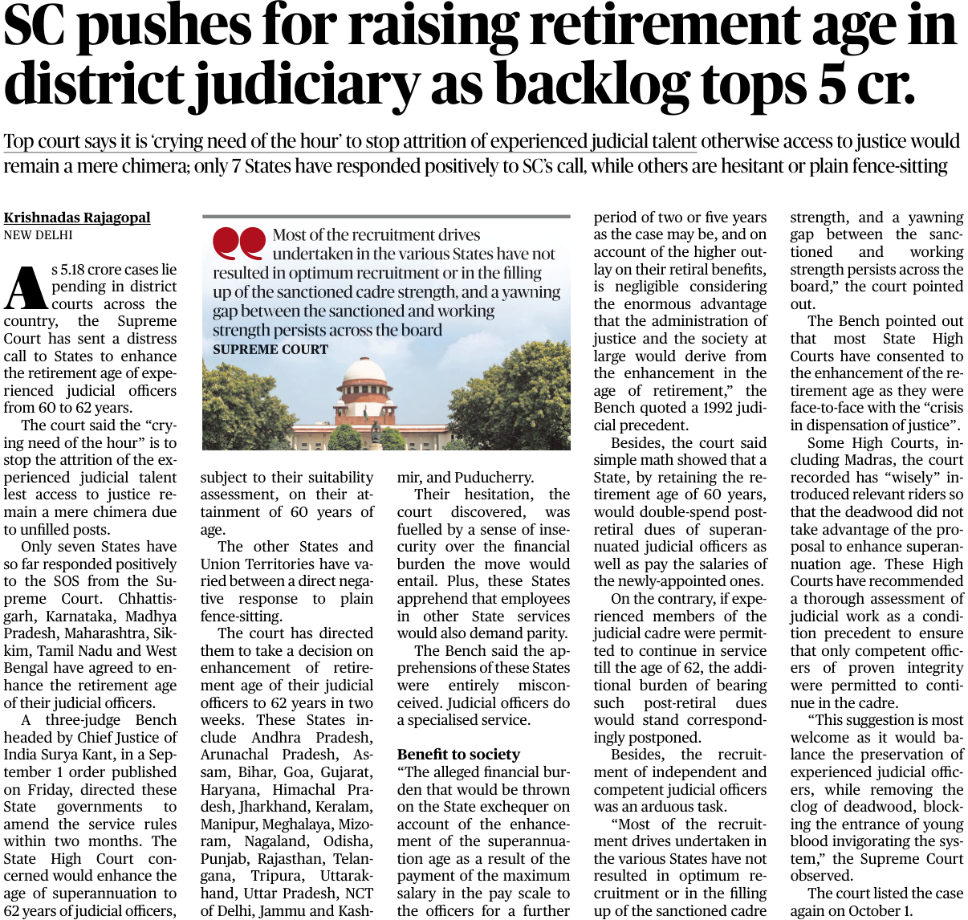
Core Analysis: Need & Arguments
Retention of Experienced Talent: Retaining trained and seasoned judicial officers directly mitigates the continuous attrition gap, preventing sudden loss of institutional knowledge amidst high case burdens.
Addressing Shortages & Recruitment Lags: Recruitment drives across states frequently fail to fill sanctioned positions, leaving wide gaps between approved and working judge strength.
Refuting Financial Burden Concerns: The court noted that extending service defers immediate post-retiral pensionary payouts. States avoid the simultaneous dual expense of paying retirement benefits to outgoing judges while funding salaries for new inductees.
Distinct Constitutional Status: Judicial officers are not standard civil servants. Their separate service classification justifies differential retirement ages compared to general state administrative cadres.
Performance Assessment Safeguards: To avoid retaining underperforming personnel ("deadwood"), extensions from 60 to 62 years remain strictly subject to a rigorous suitability evaluation by the respective High Court.
Related Static Dimensions (UPSC Syllabus)
GS Paper II – Indian Judiciary & Governance:
Article 233 & 235: Governs the appointment, control, and service conditions of the district judiciary, placing administrative superintendence under the respective High Courts.
Judicial Pendency & Reforms: Examines institutional bottlenecks, judge-to-population ratios, and structural delays impacting fundamental rights under Article 21 (Right to Speedy Justice).
GS Paper II – Constitutional Posts & Separation of Powers:
S.P. Gupta (1981) & All India Judges Association Cases: Precedents establishing that the judicial cadre operates as an independent, distinct class deserving unified service terms distinct from the executive.
Institutional Response Status
Consenting States (2-Month Timeline to Amend Rules):
Chhattisgarh
Karnataka
Madhya Pradesh
Maharashtra
Sikkim
Tamil Nadu
West Bengal
Hesitant / Non-Consenting States & UTs (Directed to Decide in 2 Weeks):
Andhra Pradesh, Bihar, Uttar Pradesh, Delhi, Punjab, Haryana, Rajasthan, Kerala, Gujarat, and 16 others.
Mandatory Prerequisite:
Performance and integrity evaluation by the jurisdictional High Court at age 60 before extending service to 62.
Conclusion
Increasing the superannuation age of subordinate judges balances talent retention with systemic productivity. Coupled with stringent performance filters by High Courts, this administrative measure serves as a crucial interim reform to stabilize working strength, curtail vacancy-driven backlogs, and ensure meaningful access to justice.
UPSC Prelims Practice Questions Question: Articles 233 and 235 of the Constitution are primarily associated with: A. Appointment and control of the subordinate judiciary B. Appointment of Supreme Court judges C. Emergency provisions D. Inter-State water disputes Ans: A) UPSC Mains Practice Questions Question: “The subordinate judiciary is the foundation of India's justice delivery system, yet it remains the most capacity-constrained tier of the judiciary.” Discuss.(10 Marks, 150 Words) |
Page 06: GS III: Environment
Context
The UNEP report Limiting Overshoot highlights the imminent threat of breaching the 1.5∘C warming threshold, warning that relying solely on post-overshoot recovery ("peak and decline") poses irreversible ecological risks. With global policies pointing toward a 2.6∘C rise and short-term risks heightened by El Niño cycles, international scrutiny is expanding beyond long-term carbon dioxide (CO2) abatement to short-lived climate pollutants (SLCPs), particularly methane. This shift challenges India’s traditional position as a low-emitting developing nation, requiring an updated global messaging strategy.
Core Analysis & Geopolitical Shift
Shift to Non-CO2 Mitigation: Methane accounts for approximately 0.5∘C of current global warming. Initiatives like the Global Methane Pledge target a 30% reduction by 2030. India’s hesitation to join stems from its agricultural structure, where methane emissions originate primarily from rice paddies and enteric fermentation in livestock—sectors vital to rural livelihoods.
Neighborhood Concerns: Statements from smaller South Asian neighbors (such as Nepal’s references to large regional economies) reflect a growing perception that major Asian emitters impact immediate regional microclimates and Himalayan ecosystems.
Adaptation vs. Mitigation Imbalance: Global climate discourse continues to prioritize immediate mitigation metrics over adaptation finance mechanisms—a core requirement for developing economies managing historical climate vulnerabilities.
Evolving Perception Risk: Sticking solely to "historical emission equity" risks isolating India internationally, especially as developing partners and vulnerable island nations demand accountability from all major regional economies.

Static Dimensions (UPSC Syllabus Core)
GS Paper III – Environmental Conservation & Climate Change:
UNFCCC Framework & Paris Agreement: Operational mechanics of Nationally Determined Contributions (NDCs), Loss and Damage Funds, and the 1.5∘C threshold under global stocktakes.
Methane Emission Dynamics: High Global Warming Potential (GWP) of CH4 (~28–36 times that of CO2 over 100 years). India's domestic initiatives include Harit Dhara (anti-methanogenic feed supplement) and System of Rice Intensification (SRI).
GS Paper II – International Relations:
South Asian Regional Climate Diplomacy: Strategic leadership in the Indian Ocean Rim and Himalayan regions (e.g., Coalition for Disaster Resilient Infrastructure - CDRI) to address transboundary climate risks.
Key Actionable Strategic Steps
Evolve the Diplomatic Narrative: Proactively frame domestic climate actions—such as renewable energy expansion, green hydrogen, and ethanol blending—as leadership contributions rather than defensive responses.
Targeted Sectoral Methane Strategy: Focus methane reduction efforts on municipal solid waste management and fugitive industrial leaks rather than smallholder agriculture.
Strengthen Regional Partnerships: Collaborate with South Asian neighbors on transboundary disaster management, glacial lake outburst flood (GLOF) monitoring, and joint Himalayan ecosystem preservation.
Demand Adaptation & Tech Parity: Keep advocating for affordable technology transfers and transparent adaptation finance, while actively building resilient domestic infrastructure.
Conclusion
Navigating a 1.5∘C warmer world requires India to balance domestic development needs with a modernized diplomatic approach. By combining internal resilience with proactive, constructive global engagement, India can protect its economic interests while upholding its role as a responsible global climate leader.
UPSC Mains Exam Study Questions Question: Discuss the major sources of methane emissions in India and suggest a sector-specific methane mitigation strategy.(10 Marks, 150 Words) |
Page 06: GS II : International Relations
Context
India's decision to revise its 2015 Model Bilateral Investment Treaty (BIT) offers an opportunity to rebalance investment protection with the state's sovereign right to regulate. While substantive legal reforms—such as streamlined international arbitration mechanisms—are critical, addressing the procedural "democratic deficit" in treaty-making is equally vital to ensure transparency, domestic legitimacy, and multi-stakeholder participation.

Core Analysis & Institutional Challenges
Limitation of the 2015 Model: The 2015 text heavily favored state regulatory power, creating hesitation among major capital-exporting nations and resulting in very few signed treaties.
Investment Friction: Investor skepticism has been exacerbated by perception of high domestic regulatory risks, institutional delays, and judicial backlogs.
The "Democratic Deficit": International economic treaties directly impact domestic governance and citizens. Closed-door executive negotiations risk alienating key societal stakeholders and bypassing parliamentary oversight.
Global Best Practices: Capital-exporting democracies (e.g., UK, Australia, Norway, Colombia) mandatorily table negotiated texts in Parliament or hold public consultations before final ratification.
Static Dimensions (UPSC Syllabus Core)
GS Paper II – Constitutional Governance & Separation of Powers:
Executive vs. Legislative Oversight: Article 73 and Article 253 govern executive power in negotiating and implementing international treaties. Incorporating parliamentary committees strengthens legislative scrutiny over international agreements.
Participatory Democracy: Engaging civil society and research institutions upholds the "all-affected principle" in public policy formulation.
GS Paper III – Indian Economy & Foreign Direct Investment (FDI):
Ease of Doing Business: Transparent BIT frameworks reduce investor risk premiums, stabilize foreign capital inflows, and safeguard domestic policy space in public health, environment, and taxation.
Key Actionable Steps for a Consultation Roadmap
Form an External Expert Core Committee: Engage independent international investment lawyers, academicians, and economists to serve as a technical advisory panel.
Broaden Multi-Stakeholder Deliberations: Formalize consultation channels with industry associations, law firms, arbitrators, and civil society groups.
Public Domain Release: Draft and publish the revised model treaty online to invite public comments, mirroring the Law Commission of India's (LCI) 2015 consultative exercise.
Parliamentary Scrutiny: Present the draft model BIT before Parliament and relevant Department-Related Standing Committees for legislative discussion prior to Cabinet approval.
Conclusion
A balanced Bilateral Investment Treaty must protect foreign capital while safeguarding national policy autonomy. Broadening external consultation and ensuring parliamentary discussion will resolve institutional friction, reduce legal vulnerability, and reinforce India's credentials as a stable destination for long-term foreign investment.
UPSC Mains Exam Study Questions Question: Examine the constitutional relationship between executive treaty-making power and parliamentary oversight in India. How can institutional consultation strengthen democratic legitimacy without undermining executive flexibility?(10 Marks, 150 Words) |
Page : 06 : Editorial Analysis :

GS Paper II: International Relations UPSC Mains Exam Practice Questions: “India’s traditional Gulf policy was driven by energy, remittances and diaspora, but contemporary West Asia increasingly demands strategic and security engagement.” Discuss.(15Marks, 250 Words) |
Context :
In The Hindu editorial, Dr. Shashi Tharoor critically examines the fundamental structural shift occurring in West Asia. For decades, India operated in the region under "deliberate ambiguity" or "multi-alignment," viewing the Gulf primarily through an economic and transactional lens—focusing on crude oil, labor export, and remittances. However, the emergence of a severe security vacuum (driven by US selective engagement) and new security groupings—most notably the Mecca Joint Defence Agreement between Saudi Arabia, Türkiye, and Pakistan—signals that West Asia’s security architecture is being rewritten. Tharoor argues that passive economic presence is no longer sufficient; India must transition into an active hard-power net security provider to protect its national security interests.
Analytical Core: Strategic Shift in West Asia
The Fall of Legacy Diplomacy: Multi-alignment and transactional commerce worked when the US served as the sole regional security guarantor. With Washington's pullback, regional powers no longer value strategic ambiguity; they actively seek hard security guarantees.
Emergence of Counter-Axes (The Mecca Pact): The trilateral agreement links Gulf capital (Saudi Arabia), defense technology (Türkiye), and military manpower/skills (Pakistan). This forms a collective defense architecture right at India’s western maritime doorstep.
Fragility of Hyper-Economic Networks: Recent regional conflicts demonstrate that state-of-the-art infrastructure, ports, and trade corridors are extremely vulnerable to low-cost asymmetric grey-zone warfare (e.g., drone/missile strikes in the Red Sea, Bab el-Mandeb, and Strait of Hormuz).
Threat to Indian Interests: Strategic silence risks marginalizing New Delhi. Disruption of maritime choke points threatens India's energy security, trade supply chains, and the welfare of the Indian diaspora in the Gulf.
Strategic Imperatives & Hard-Power Moves for India
Naval Footprint Expansion: India must project hard power across key choke points (Strait of Hormuz, Gulf of Oman, Bab-el-Mandeb, and Gulf of Aden) through joint maritime patrols, surveillance networks, and logistics access arrangements.
Defense Industrial Collaboration: Leverage India's defense manufacturing ecosystem to offer Gulf nations hardware, joint technology ventures, and counter-terrorism capabilities as alternatives to traditional or hostile suppliers.
Minilateralism over Passive Presence: Build proactive bilateral and minilateral security frameworks with key regional players (such as UAE, Israel, and Saudi Arabia) to create deterrence against hostile security axes.
Related Static Dimensions (UPSC Integration)
Choke Points & Maritime Geography:
Strait of Hormuz: Connects Persian Gulf to Gulf of Oman; primary global oil transit chokepoint.
Bab-el-Mandeb: Connects Red Sea to Gulf of Aden; key gateway to the Suez Canal.
India’s Policy Evolution: Shift from Look West Policy (2005) focused on energy/diaspora to proactive hard-power engagement under SAGAR (Security and Growth for All in the Region).
Net Security Provider Concept: India's capacity to ensure maritime domain awareness, Search and Rescue (SAR), and Anti-Piracy Operations in the Indian Ocean Region (IOR).
Way Forward & Conclusion
India’s foreign policy in West Asia must shift from defensive transactionality to strategic deterrence. Relying solely on diaspora diplomacy and bilateral trade will leave India vulnerable to the geopolitical choices made by regional and hostile axes. By actively integrating naval power, defense exports, and intelligence-sharing mechanisms into its diplomatic framework, New Delhi can safeguard its maritime trade routes, secure its energy needs, and solidify its position as an indispensable regional power. Strategic distance must give way to strategic presence.

Comments