7th August- The Hindu Newspaper Analysis
Page 05: GS II : Indian Polity
Context
The Rajya Sabha recently considered and returned the Appropriation (No. 3) Bill, 2026. This Money Bill authorizes the retrospective regularisation of ₹54,067 crore spent during the 2022–23 financial year from the Consolidated Fund of India.

Key Dimensions & News Analysis
Breakdown of Excess Spending:
Debt Repayment: ₹53,871 crore was utilized for redeeming government securities (no net fiscal impact).
Judicial Orders: ₹196.44 crore was allocated to satisfy a court judgment involving the Ministry of Railways.
Scrutiny by Public Accounts Committee (PAC): These excess demands were pre-examined by the PAC and detailed in its 39th Report presented to the Lok Sabha in April.
Financial Assistance to J&K and Ladakh:
The Union Government directly pays ~₹13,000 crore annually for J&K Police salaries and pensions.
Granted an additional ₹5,000 crore annually for FY 2024–25 and FY 2025–26 alongside restructuring J&K's debt and clearing Ladakh's debt.
Related Static Concept: Appropriation Bill & Excess Grant
Appropriation Bill (Article 114):
Mandates that no money can be withdrawn from the Consolidated Fund of India (CFI) without parliamentary authorization.
Classified as a Money Bill (Article 110); Rajya Sabha cannot amend or reject it, only return it within 14 days.
Demand for Excess Grants (Article 115):
Triggered when money spent on a service during a financial year exceeds the amount granted for that service in the budget.
Prerequisite: Must be vetted by the Public Accounts Committee (PAC) before submission to Parliament for voting in the Lok Sabha.
Conclusion
The passage of the Appropriation Bill reflects the constitutional mechanism of parliamentary control over public finance, ensuring strict scrutiny by the PAC while regularizing essential national and regional expenditures.
UPSC Prelims Practice Questions
Question: Which of the following Committees is primarily responsible for examining excess expenditure incurred by the Government after it has been audited by the CAG?
A. Estimates Committee
B. Committee on Public Undertakings
C. Public Accounts Committee (PAC)
D. Business Advisory Committee
Ans: A.
UPSC Mains Practice Questions
Question: Examine the constitutional provisions relating to Appropriation Bills and Excess Grants. How do they strengthen financial accountability in India?(10 Marks, 150 Words)
******
Page 08 :GS III : Internal Security
Context
The Directorate General of Maritime Administration (DGMA) issued a critical advisory cautioning against rising cyberthreats targeting Indian ports as they rapidly digitize and automate. With the integration of Information Technology (IT) and Operational Technology (OT) networks, modern ports are increasingly exposed to malware, ransomware, and unauthorized breaches.

Key Highlights of the Advisory
Vulnerable Operational Assets: Systems like Terminal Operating Systems (TOS), Vessel Traffic Management Systems (VTMS), cargo infrastructure, and surveillance networks face significant risks.
ISPS Code Alignment: Mandates integrating cybersecurity risk assessments into existing Port Facility Security Assessments (PFSA) and Port Facility Security Plans (PFSP).
Resilience & Testing: Recommends continuous backup testing, disaster recovery simulations, and regular threat awareness drills for Port Facility Security Officers (PFSOs).
Strategic & Economic Impact for India
Supply Chain Disruptions: Over 90% of India’s trade by volume moves via maritime transport. A cyber incident halting port operations can ripple across national supply chains, causing inflation and economic loss.
Geopolitical Vulnerability: Maritime assets are designated Critical Information Infrastructure (CII). State-sponsored cyber warfare against major trade hubs poses a direct threat to sovereignty.
Related Static Dimensions (UPSC Core Integration)
International Frameworks:
ISPS Code: Developed under the International Maritime Organization (IMO) SOLAS Convention (1974) to manage maritime security threats.
IMO Resolution MSC.428(98): Mandates maritime cyber risk management integration into safety management systems.
Institutional Architecture in India:
NCIIPC (National Critical Information Infrastructure Protection Centre): Protects strategic maritime infrastructure under the IT Act, 2000 (Section 70A).
CERT-In (Indian Computer Emergency Response Team): Coordinates incident response across strategic sectors.
National Cyber Security Policy: Framework to strengthen cyber resilience across critical assets.
Key Challenges
IT-OT Convergence Risks: Older physical operational machinery connected to modern IP-based networks lacks built-in security features.
Third-Party Vendor Exposure: Supply chain security remains vulnerable to external logistics contractors accessing port portals.
Skill Deficit: Shortage of specialized cyber-maritime professionals trained to handle combined operational and digital security.
Way Forward
Implement strict network segmentation separating operational systems (OT) from administrative networks (IT).
Conduct mandatory, periodic zero-trust architecture audits across major and non-major ports.
Align port security measures with the National Cybersecurity Strategy to establish standard reporting protocols.
Conclusion
As India accelerates its maritime sector modernization under the Sagarmala Programme, maritime security must expand beyond physical perimeter defence to comprehensive digital resilience. Integrating robust cybersecurity protocols into everyday port administration is essential to safeguard national trade, ensure economic continuity, and secure critical infrastructure against evolving cyber warfare.
UPSC Mains Practice Questions
Question: India's ports are increasingly becoming part of the country's Critical Information Infrastructure (CII). Examine the cyber threats they face and suggest a comprehensive strategy to strengthen maritime cyber resilience.(10 Marks, 150 Words)
******
Page 09 : GS II : Governance
Context
The scaled-down Glasgow Commonwealth Games has revived debate over the long-term viability of multi-sport mega-events. With rising financial costs and dwindling global bidders, the CWG faces an existential crisis, raising the pivotal question: Should the Commonwealth Games be scrapped, or reformed?

Core Analysis: Critical Issues and Strategic Imperatives
Economic Viability & Financial Strain: Hosting traditional multi-sport events often causes severe fiscal strain and long-term debt due to underutilized infrastructure ("White Elephants"), as seen in past Olympic hosts.
Dropping Core Disciplines & Squad Restrictions: To manage budgets, host cities are capping athlete quotas and excluding key medal-heavy sports like shooting, wrestling, and badminton, eroding the competitive standard of the Games.
Psychological & Developmental Value for Athletes: Despite lower technical difficulty compared to World Championships, CWG serves as an essential stepping-stone for athletes to experience village life, handle media pressure, and test strategies before the
Asian Games and Olympics.
The Decentralized Co-Hosting Model: A sustainable alternative involves multi-city or multi-nation hosting (similar to FIFA events) or allowing sport-specific regional hosting (e.g., India hosting shooting or wrestling events).
Static & Policy Dimensions
Governance & Soft Power: Sports diplomacy serves as a instrument of soft power projection. India’s strategic utilization of CWG 2030 in Ahmedabad supports its bid for the 2036 Olympic Games.
Economic Development & Infrastructure: Sports infrastructure development aligns with government initiatives such as Khelo India and FIT India Movement. Capital expenditure on sustainable sports hubs creates long-term urban utility.
Conclusion
Rather than scrapping the Commonwealth Games, sports bodies must reform the event through cost-sharing, multi-country hosting, and flexible discipline selection. For India, strategic engagement with CWG acts as a crucial catalyst for building world-class infrastructure, nurturing youth talent, and establishing the nation as a global sporting superpower.
UPSC Prelims Exam Study Questions
Question: The term "White Elephant Infrastructure", often used in discussions on mega sporting events, refers to:
A. Eco-friendly sports stadiums.
B. Infrastructure that becomes economically unsustainable or underutilized after the event.
C. Temporary sports facilities built using recyclable materials.
D. Heritage sports venues protected by UNESCO.
Ans: B)
UPSC Mains Exam Study Questions
Question: "Sports diplomacy has emerged as an important instrument of soft power in contemporary international relations." Discuss with reference to India's sporting ambitions.(10 Marks, 150 Words)
******
Page 08 : GS III : Indian Economy
Context
The Indian gold market is undergoing a structural paradigm shift, moving from a traditional cultural commodity to a modern financial asset. As highlighted by recent trends, despite record-high gold prices, households are choosing to pledge gold for loans rather than sell it, while financial gold (ETFs, bars, coins) is steadily outpacing traditional jewelry demand.

Key Drivers of the Structural Shift
Pledging over Liquidation (The Monetization Preference):
Emotional & Asset Security: Gold in India carries immense sentimental and generational value. Households treat it as an emergency liquidity cushion rather than a disposable asset.
Surge in Gold Loans: Outstanding gold loans in the formal banking sector crossed ₹5.4 lakh crore by mid-2026 (a nearly 94% YoY growth). Soaring gold prices allow households to secure larger loan amounts against the same weight.
Affordability vs. Investment Realities:
Declining Jewellery Demand: Sharp price escalation (from ~₹28,000/10g in 2016 to over ₹1.5 lakh/10g in 2026) has created severe affordability pressures, driving jewellery demand to historic lows.
Rise of Financial Gold: Urban and younger investors increasingly prefer gold ETFs, digital gold, and coins over jewellery due to lower making charges, absence of storage risk, high liquidity, and purity assurance.
Macroeconomic Anchoring & Sovereign Balance:
Reserve Bank Cushion: Increased gold purchases by the RBI, combined with massive household gold stocks, act as an economic shock absorber against rupee depreciation and foreign portfolio investment (FPI) outflows.
Key Regulatory & Systemic Challenges
Systemic Risk in Gold Lending: Rapid expansion in gold-backed loans poses credit risks if gold prices experience a sharp sudden correction. In response, the RBI has tightened norms, enforcing mandatory full settlement before repledging.
Failure of Physical Monetization: Schemes like the Gold Monetization Scheme (GMS 2015) remain underutilized due to procedural hurdles, fear of tax scrutiny, and cultural reluctance to melt heirloom jewellery.
Static Dimensions
Current Account Deficit (CAD): India is one of the world's largest importers of gold. High gold imports strain foreign exchange reserves and widen the CAD. Monetizing domestic idle gold helps curb import dependence.
Financialization of Household Savings: Transitioning household savings from physical assets (gold, real estate) to financial assets (ETFs, mutual funds) improves capital formation in the formal economy.
Inflation Hedge & Macro-Stability: Gold acts as a zero-counterparty risk asset and a natural hedge against systemic inflation and currency volatility.
Conclusion
India’s massive, privately held household gold reserve is transitioning from a passive store of value into an active financial instrument. To fully unlock this potential without overexposing the banking sector to risk, India needs robust digital transparency, simplified monetization frameworks, and deeper integration between physical gold reserves and formal capital markets.
UPSC Prelims Practice Questions
Question: Which one of the following best explains the term financialization of household savings?
A. Increase in government expenditure through public borrowing.
B. Shift in household savings from physical assets to financial instruments.
C. Increase in corporate taxation.
D. Expansion of foreign direct investment.
Ans: B)
UPSC Mains Practice Questions
Question: "India's gold economy is witnessing a transition from a cultural asset to a financial asset." Discuss its implications for the economy and financial sector.(10 Marks, 150 Words)
******
Page 11: GS III : Environment
Context
The Supreme Court of India recently clarified that its February 2024 interim directive—requiring prior approval from the Standing Committee of the National Board for Wildlife (SC-NBWL) or MoEFCC for mining within a 10-km radius of the Asan Wetland Conservation Reserve—applies to all similar wetland conservation reserves nationwide for the sake of parity.
Key Clarifications & Impact
Judicial Safeguard Extension: The ruling prevents regulatory arbitrage across state boundaries (e.g., contiguous Himalayan terrain between Uttarakhand and Himachal Pradesh).
Heightened Scrutiny: Project proponents must seek explicit wildlife/environmental clearances from central authorities before commencing mining within 10 km of designated wetland reserves.
Impact on Extraction: Sand mining and quarrying near riverine wetland beds will face tighter judicial oversight, safeguarding aquatic hydrology and migratory bird corridors.

Significance of Asan Wetland Reserve
Ecological Value: Situated at the confluence of the Asan and Yamuna rivers in Uttarakhand, it was designated as Uttarakhand’s first Ramsar Site in 2020.
Biodiversity Hub: Serves as a vital wintering ground for trans-Himalayan migratory waterfowl.
Static Dimensions & Statutory Framework
Statutory Buffer Gap: Neither the international Ramsar Convention (1971) nor India's Wetlands (Conservation and Management) Rules, 2017 mandate a fixed statutory buffer zone or explicit distance-based mining ban around wetlands.
Shift from 2010 to 2017 Rules: The 2010 Rules contained explicit central prohibitions (reclamation, industrial dumping, hazardous activities) within a "zone of influence." The 2017 Rules decentralized powers to State Wetland Authorities (SWAs), removing explicit prohibited activity lists—a shift currently under challenge in the Supreme Court.
Comparison of Mining Restrictions Near Protected Areas
National Parks & Wildlife Sanctuaries:
Regulated under the Wildlife (Protection) Act, 1972.
Complete prohibition inside protected areas plus a minimum 1-km Eco-Sensitive Zone (ESZ) buffer nationwide, unless a larger ESZ is notified.
Wetland Conservation Reserves:
Regulated under Wetlands Rules, 2017 and local state mechanisms.
No statutory outer buffer distance; relies on judicial directives (such as the 10-km oversight rule) to fill the regulatory void.
Forest Land:
Forest diversion requires Central approval under the Van (Sanrakshan Evam Samvardhan) Adhiniyam, 1980 alongside EIA Notification, 2006 clearances.
Conclusion
The Supreme Court’s intervention fills a statutory void created by the removal of explicit buffer norms under the 2017 Wetland Rules. While it strengthens ecological protection for India's 101 Ramsar sites and wetland reserves, a long-term solution requires the Ministry of Environment to establish uniform, science-based Eco-Sensitive Zones around wetlands to harmonize conservation with sustainable economic activity.
UPSC Mains Exam Study Questions
Question: "Wetlands are among the most productive ecosystems, yet they remain one of the most threatened." Discuss the ecological significance of wetlands and examine the challenges in their conservation in India.(10 Marks, 150 Words)
******
Page : 08 Editorial Analysis
GS Paper III: Indian Economy
UPSC Mains Exam Practice Questions: Examine the contribution of the handloom sector to India's cultural identity and the freedom movement. How can this legacy be preserved in the era of globalization?(10Marks, 150 Words)
Context:
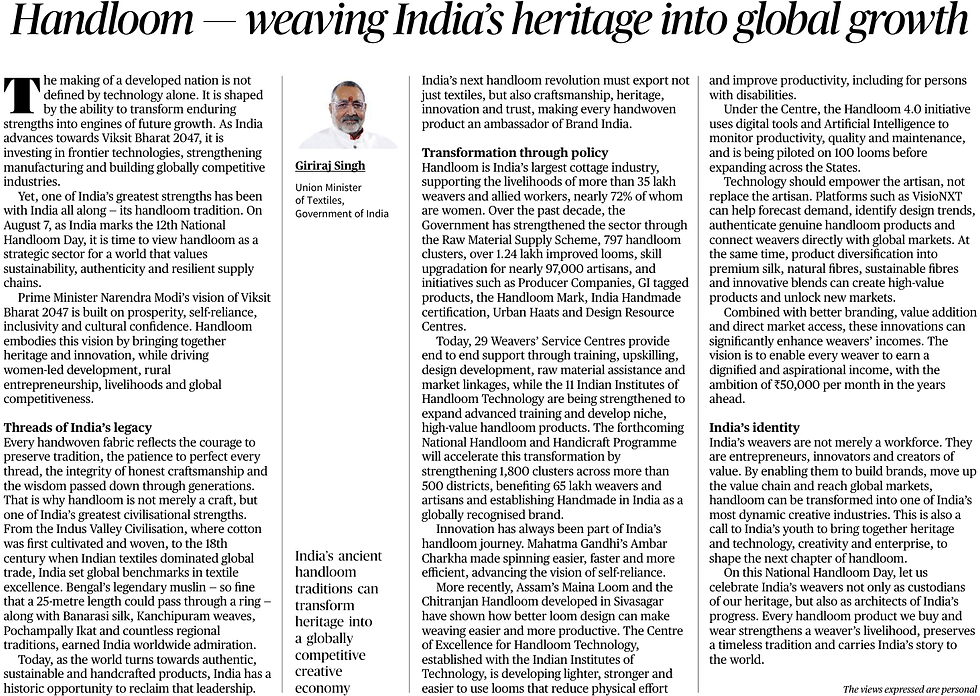
The handloom sector represents a vital intersection of India’s civilisational heritage, sustainable manufacturing, and rural economy. In his article, Union Minister of Textiles Giriraj Singh highlights how handlooms align with the vision of Viksit Bharat 2047, serving as a strategic sector for global growth while driving women-led development and rural self-reliance.
Core Analysis: Strategic Dimensions & Interventions
1. Socio-Economic Significance:
Livelihood & Inclusivity: Supports over 35 lakh weavers and allied workers, with 72% women participation, fostering gender-inclusive growth.
Rural Entrepreneurship: Forms the backbone of India’s cottage industry, mitigating distress migration by creating local employment.
2. Policy & Institutional Framework:
Cluster & Raw Material Support: Interventions like the Raw Material Supply Scheme, 797 handloom clusters, and 29 Weavers’ Service Centres (WSCs) provide end-to-end operational support.
Future Roadmap: The upcoming National Handloom and Handicraft Programme aims to cover 1,800 clusters across 500+ districts, targeting 65 lakh beneficiaries.
3. Technological Integration (Handloom 4.0):
Ergonomics & Productivity: Ergonomic innovations like Assam's Maina Loom and partnerships with IITs reduce physical strain and improve yield.
Digital Empowerment: Tools such as VisioNXT for trend forecasting, AI-driven maintenance on looms, and direct market access digital platforms bridge the gap between rural artisans and global consumers.
4. Branding & Global Competitiveness:
Authenticity Assurance: Geographical Indication (GI) tags, Handloom Mark, and India Handmade certifications protect traditional knowledge against power-loom counterfeiting.
Income Target: Focuses on value addition (natural/sustainable blends) to scale weavers' earnings toward an aspirational ₹50,000 per month.
Related Static Dimensions (UPSC Syllabus Alignment)
Art & Culture / History: Historical lineage from the Indus Valley Civilisation; legendary traditional weaves (Bengal Muslin, Banarasi Silk, Kanchipuram, Pochampally Ikat); role of Khadi and Charkha during the Freedom Movement.
Governance & Social Justice: Women empowerment policies; welfare schemes for vulnerable traditional artisan communities.
Economy & Inclusive Growth: MSME ecosystem, export promotion, sustainable industrialisation, and integration of AI in traditional sectors (Industry 4.0 meets Handloom 4.0).
Conclusion
India’s handloom sector is no longer just a custodian of cultural legacy; it is a green, women-led engine for dynamic economic growth. By harmonising traditional craftsmanship with technological empowerment (Handloom 4.0) and robust branding, India can establish "Handmade in India" as a globally trusted brand, fulfilling the objective of inclusive development under Viksit Bharat 2047.
******

Comments